A balcony over the battlefield: Dantzig Alley British Cemetery
Named after the nearby German trench captured by troops of the 7 Division on 1 July 1916, Dantzig Alley British Cemetery was created later that month when field ambulances and fighting units began using the roadside site for burials. By the end of the war it contained 183 graves, most of them victims of the fighting in 1916 and 1917. It was after the Armistice that it expanded rapidly when several cemeteries were concentrated into the site and brought the total number of burials to just over 2000.
The permanent cemetery constructed in the 1920s is a fascinating example of Herbert Baker’s influence on the design principles of the Commission, and from its nature, I suspect that A.J.S. Hutton was the assistant architect (have a look at the similarities with Lonsdale Cemetery).
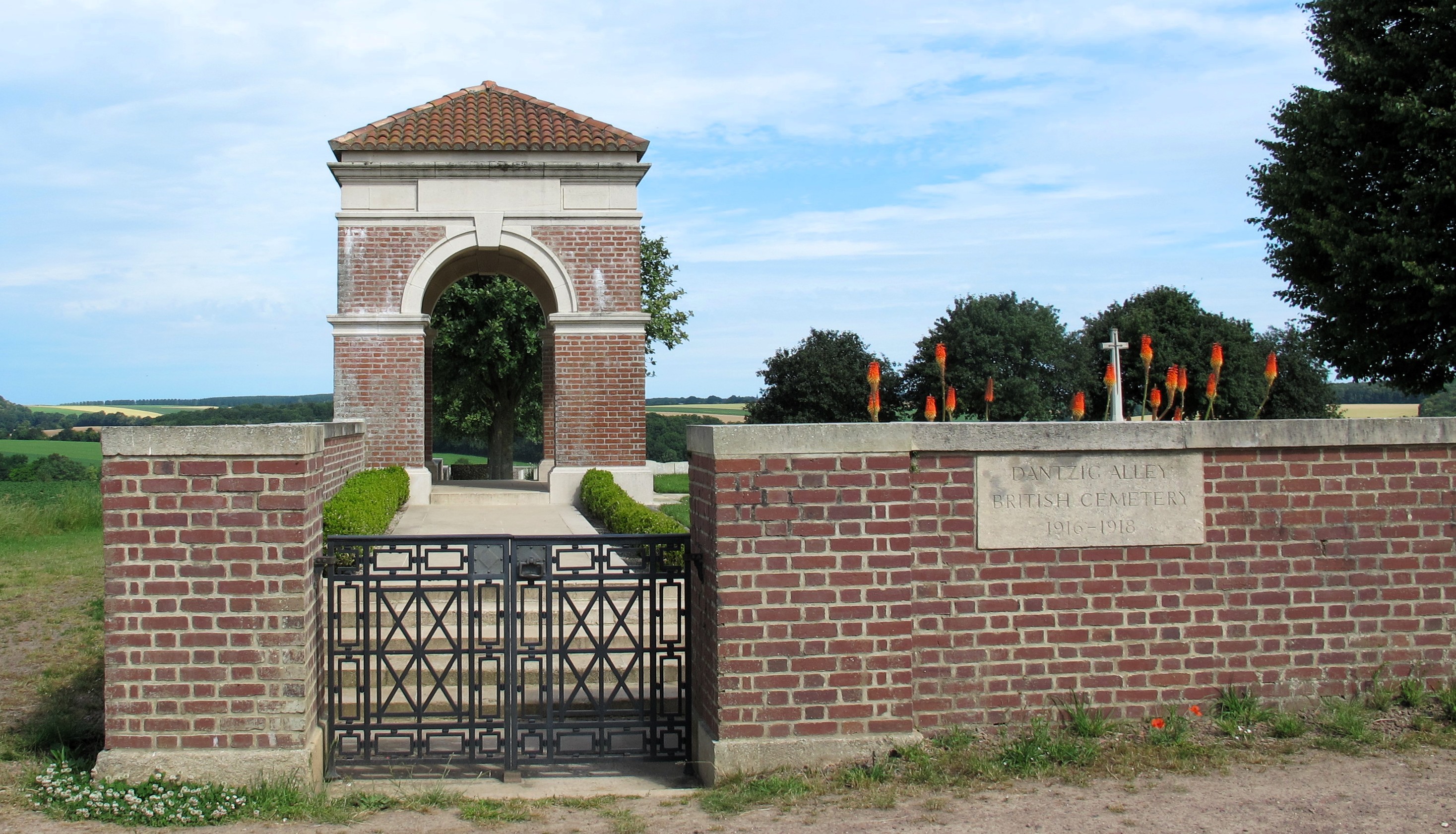
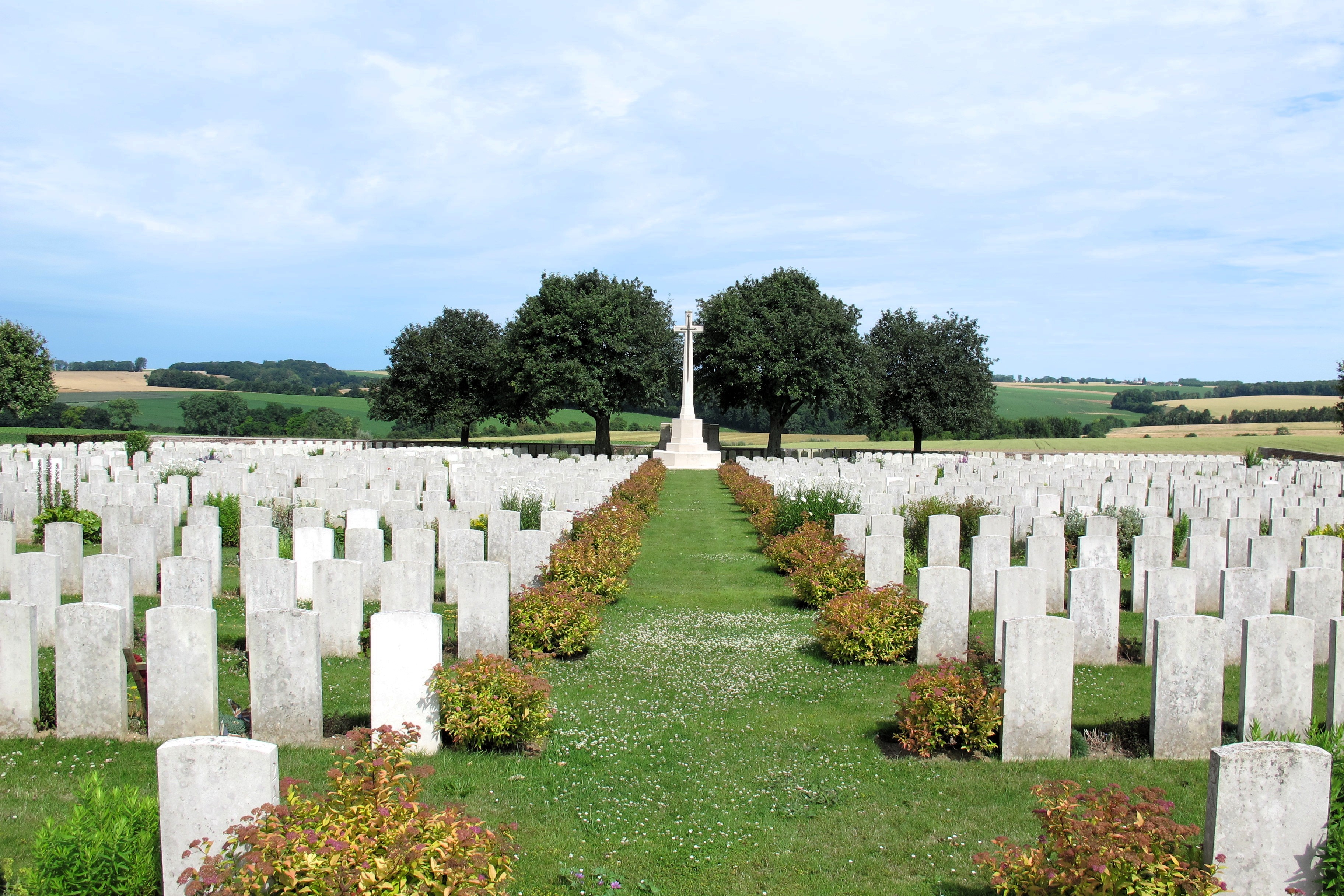
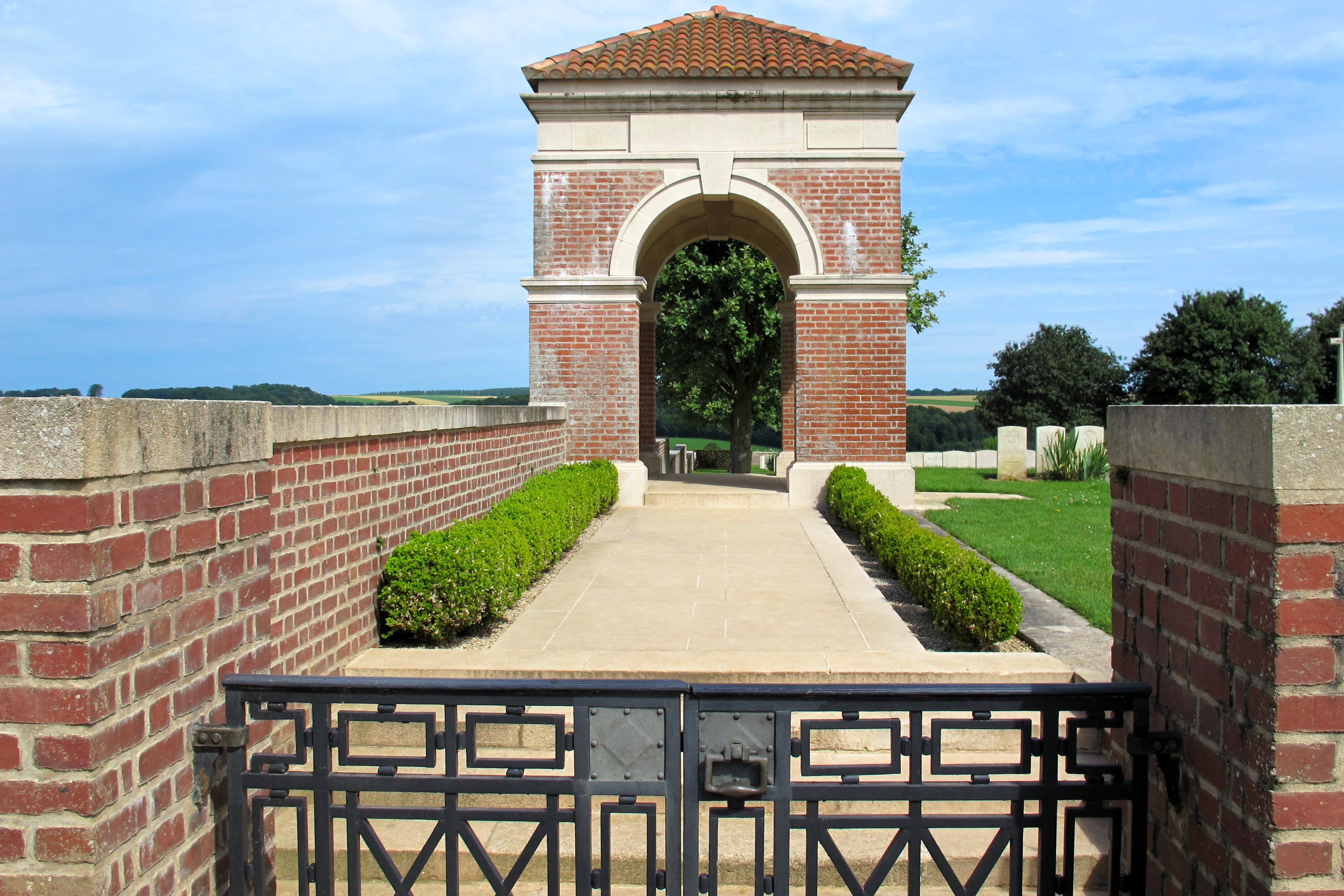
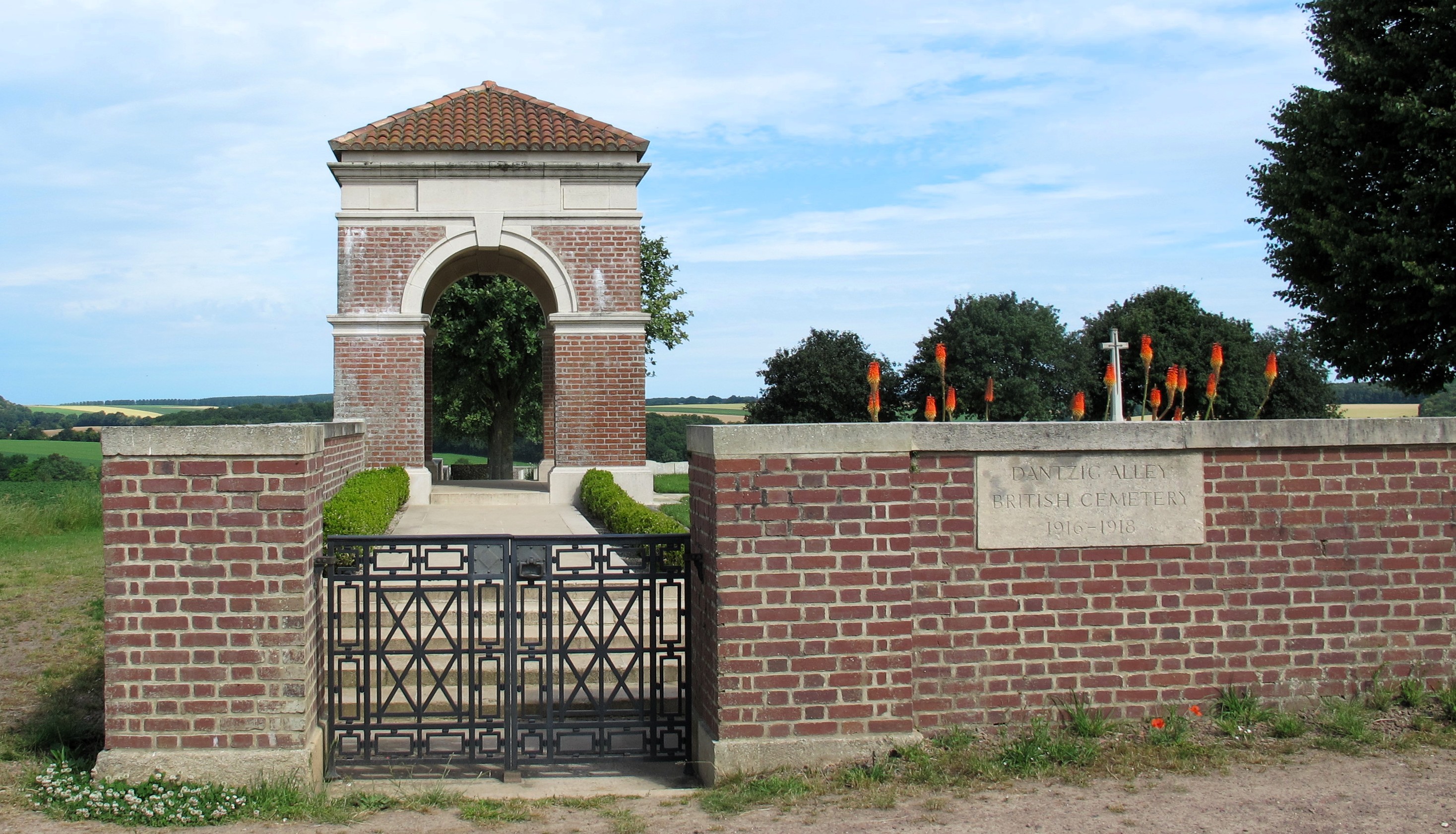
First engagement with the cemetery is a bit like encountering a highly stylised trench, for its front wall runs parapet-like, as well as tapering gently as it goes up against the gradient, and parallel with the northern-side of the main road. This wall emphasizes the horizon and leads the eye to the entrance gate tucked into the far corner angle of the wall. Here two gate piers of the same red brick and white coping stone of the enclosing wall protrude slightly outwards and house iron gates which are of the most decorative of the Commission’s standard patterns. Open the gates and step into the cemetery space and a game of levels commences as two steps are climbed to a pavement leading to the shelter. The effect of these steps ensures that the gaze takes in the gentle, but pronounced, slope of the cemetery down towards the back wall. In turn, this gives even greater distinction to the original cemetery plot which sits on its own grassed plinth against the front wall. Through this subtle device Baker and Hutton gave the core of the cemetery its own special treatment.
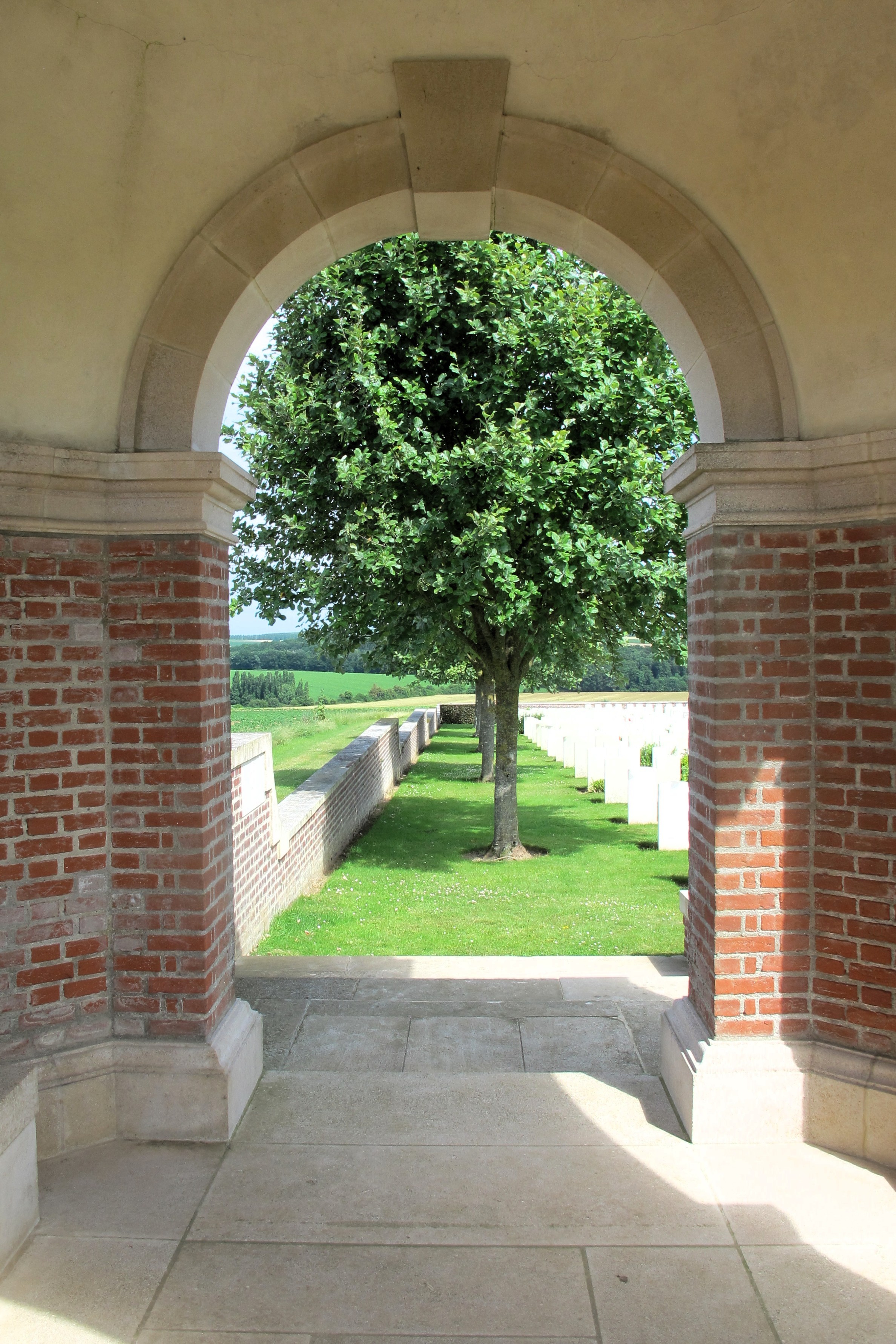
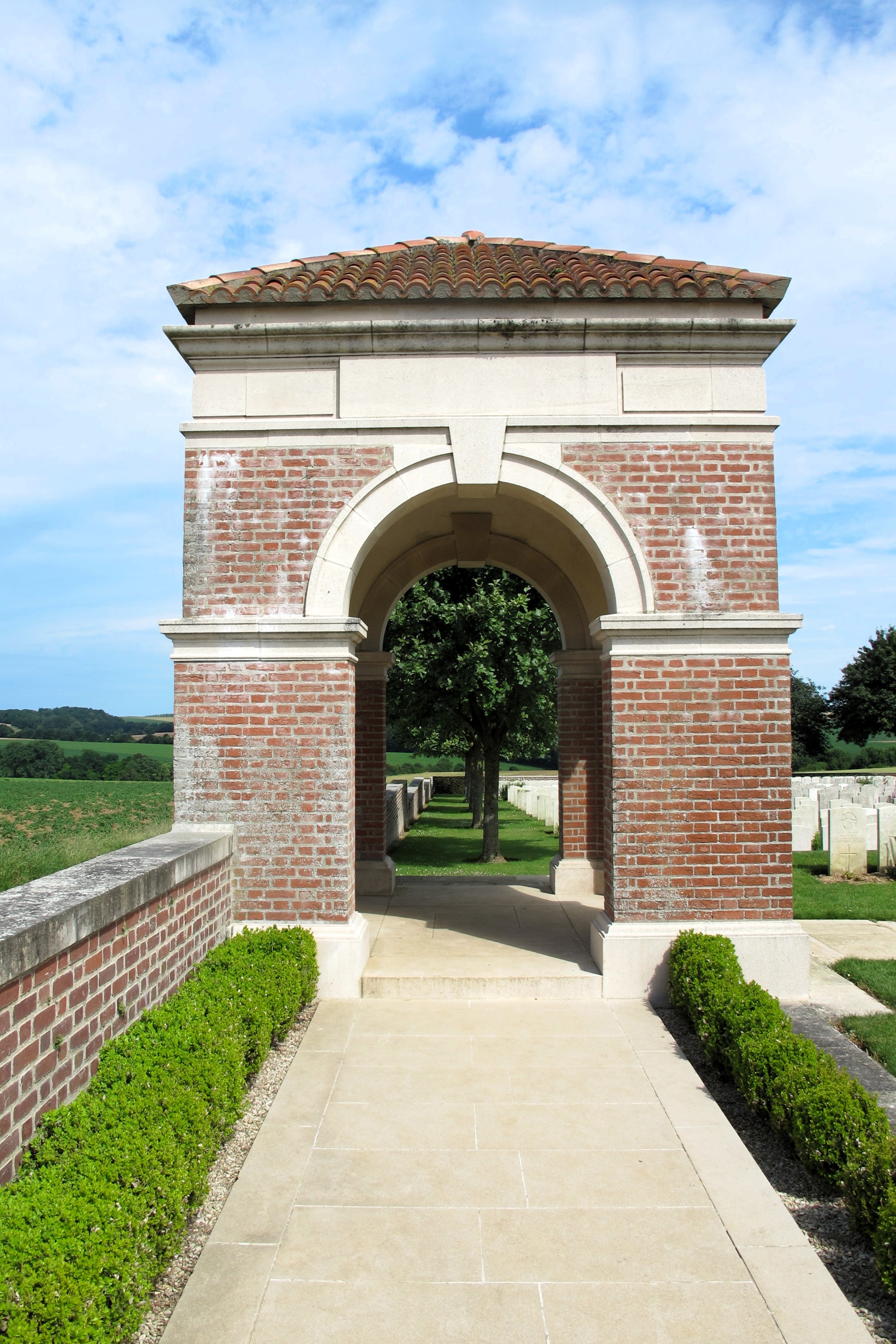
A few steps further along and the shelter pavilion is met. This is a beautiful piece of work. Red brick with white stone string courses, arches, keystone and architrave, it is capped by a wonderful pan-tiled roof. This touch seems especially Baker for it is the converging point of two of his obsessions. First, it seems very Kent to have clay tiles, and then it seems very much of the classical Mediterranean, too, as if a little bit of the Etruscan or Roman had been unearthed here. The tunnel effect it creates then also directs the eye towards the cemetery’s rear wall accessed via a grass path and what is now a tree-lined avenue. The sense of peace and ease is palpable. These men can rest eternally in this beautiful garden.
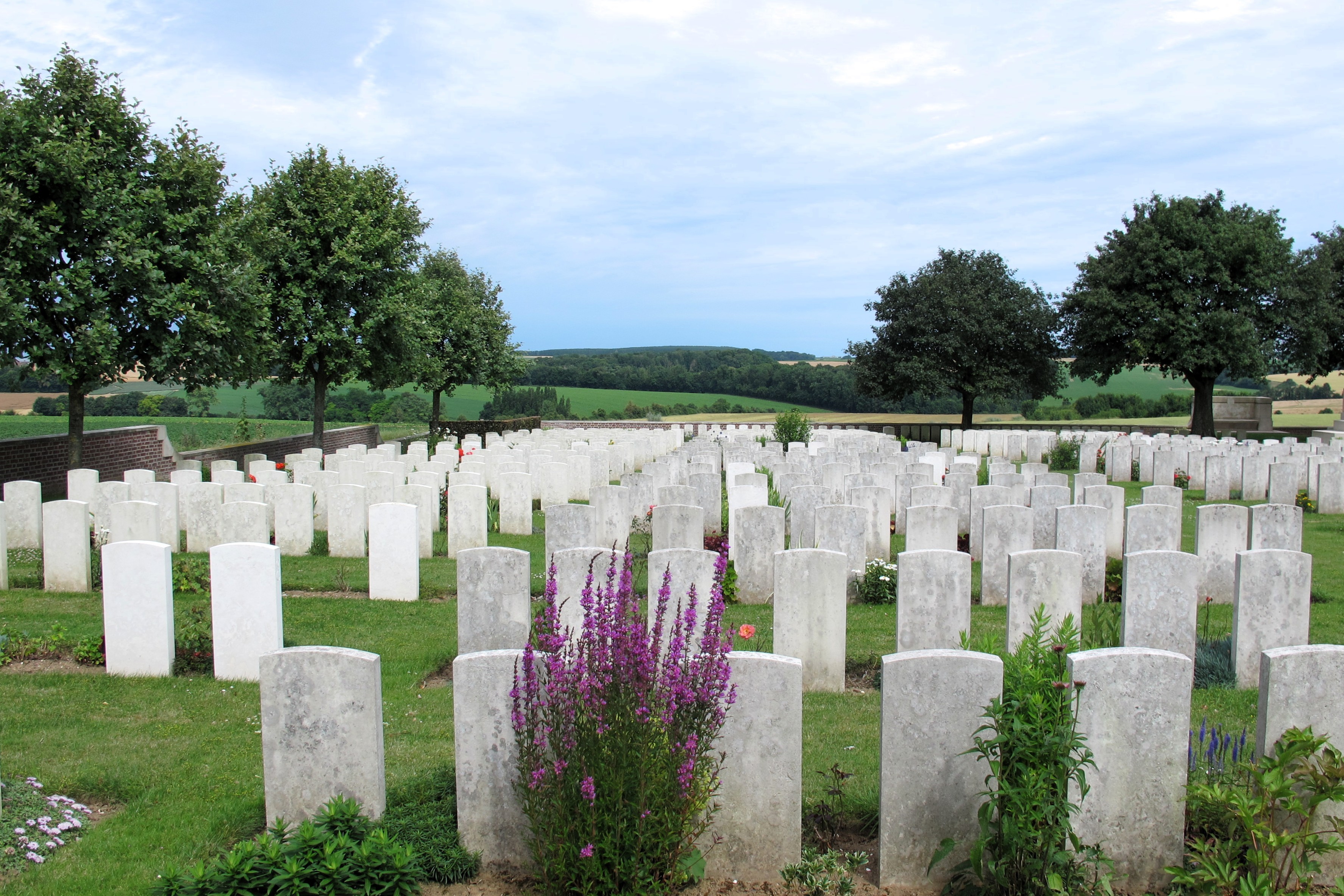
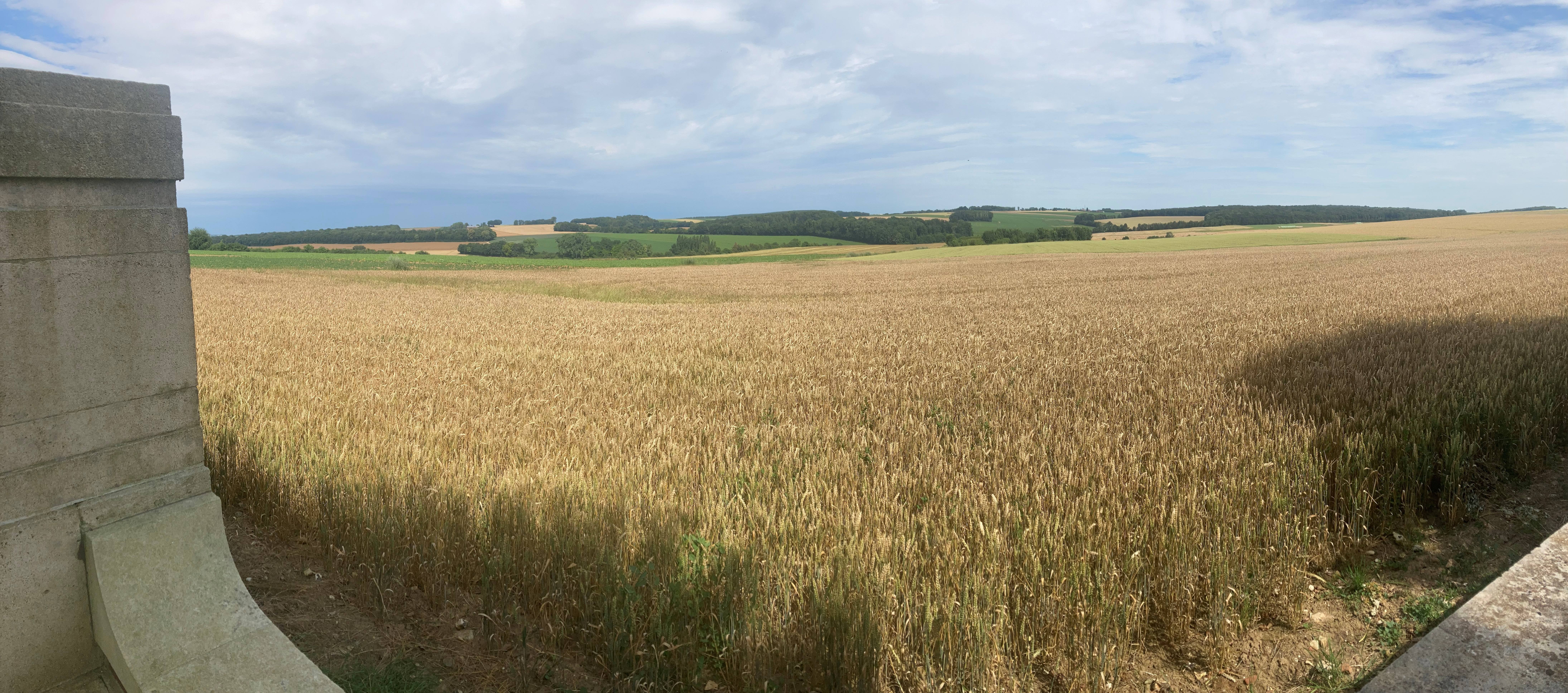
Follow that path to its end and the view across the valley is magnificent. It is tempting to think that Hutton might have explained the nature of the battle lines and movement to Baker and told him that a good view would bring the reality of the battlefield to life. H.A. Taylor, veteran of the Royal Fusiliers and General Staff, certainly recognised this quality, writing of the cemetery in 1928: ‘To anyone who knew this territory as it appeared after the battle, it is fascinating to stand at a point such as Dantzig Alley Cemetery, near Mametz, and take into view a wide sweep of the country. Over to the left is Fricourt Wood; to the right Mametz Wood, the largest of the woods hereabouts; while in the middle distance is a large copse once known as Bottom Wood, close to the old strong point of evil repute, “The Quadrilateral”’. All of these points can still be seen today. The cemetery is the grandstand.
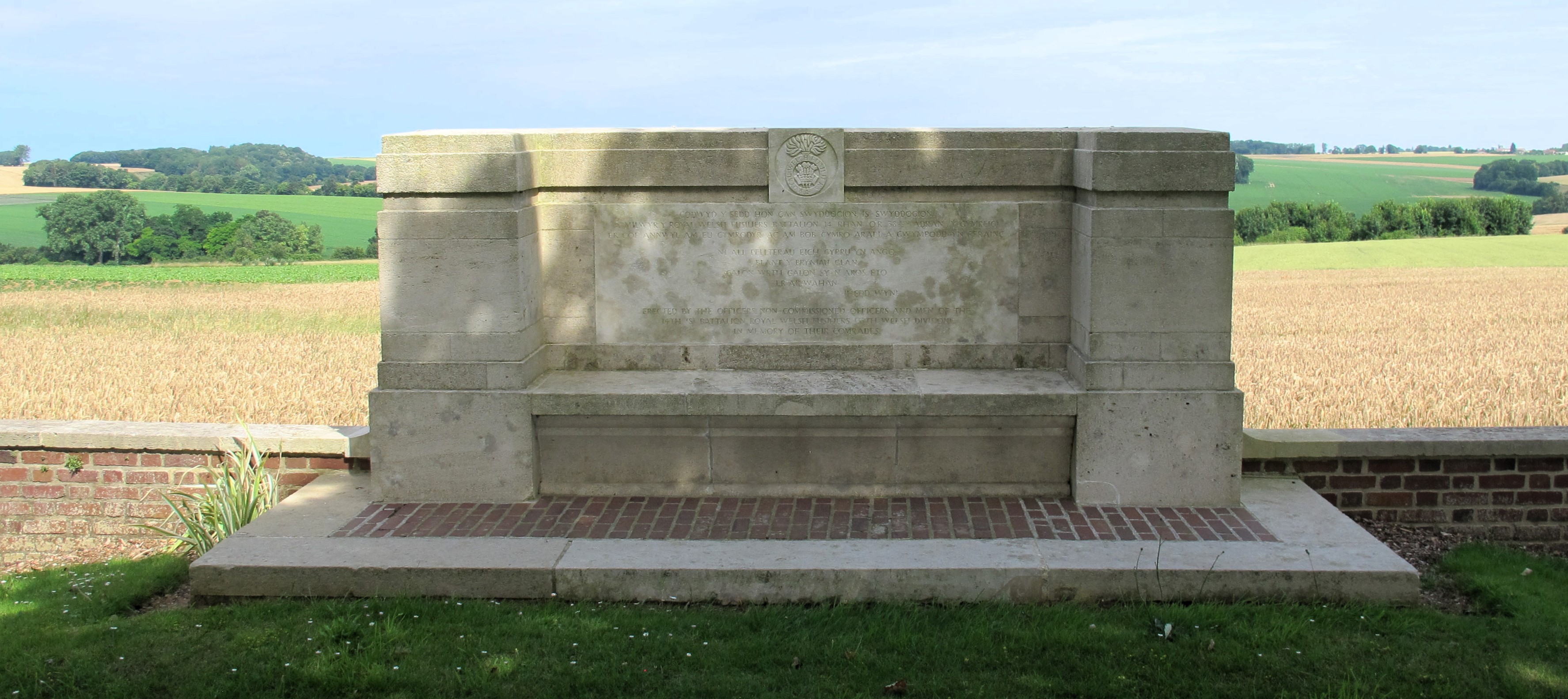
Given the deliberation with which the cemetery design ensured a view, its next feature is perhaps a little eccentric. Placed squarely in the middle of the back wall and on a grassed bank, is the memorial seat of the 14 battalion Royal Welch Fusiliers. Paid for by subscriptions and built into the wall by the Commission in the early 1930s, the slight oddity about it is that it faces away from the view and up the main axis to the front wall. I suspect neither Hutton nor Baker wished to place it along the front wall, as that would have broken up the power of the flat horizon effect. They could have placed it halfway along the eastern facing wall almost opposite the shelter and thus created a cross-axis but obviously decided not to do so. What the placing of the bench does achieve is a focus on the graves, and perhaps symbolically reminds all visitors that the cost of what was fought for in the land beyond is here in front of the eyes. This focus on the dead is made all the more clear by the fact that the bench is within the immediate shadow of the Cross of Sacrifice and on its axis line.
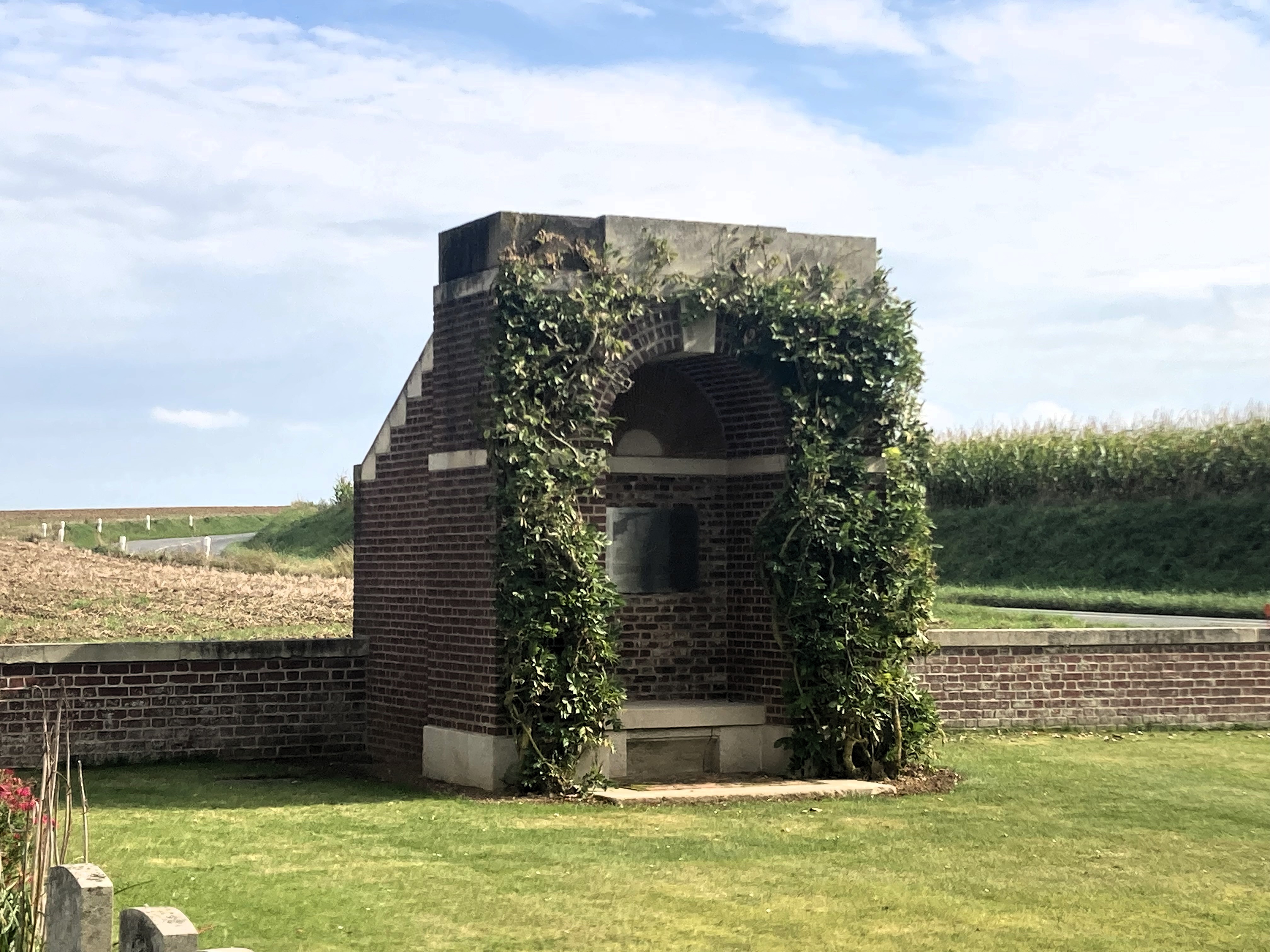
The cemetery’s final surprise is another bench, this one set into a shelter, which also doubles as a toolshed. The architecture is both beautiful and intriguing. The bench is set into a redbrick and white stone arch topped by cascading wisteria, while the rear – the toolshed section – has a sharply sliding roof, which gives the whole thing an almost deliberately whimsical air.
At Dantzig Alley Cemetery Baker and Hutton take us on the most beautiful of strolls through a wonderful garden, while also reminding asking us to imagine the horror that took place in the rolling wooded countryside just beyond its walls.
Let’s walk the Somme together and explore this and other sites.