Sitting on the top of the world: Grove Town Cemetery
To drive, cycle or walk from the village of Étinehem-Méricourt towards Meaulte means ascending from the low ground along the banks of the Somme up to a high plateau. As Martin Middlebrook stated in his guidebook to the Somme battlefields, the Rue d’Étinehem ‘would have been a bleak march in bad weather, a shadeless and sweaty one under the summer sun’. The views from this mini-tableland (perhaps coffee-tableland sums it up best) are slightly disconcerting, for being so high and so flat nothing can be seen or discerned. Morlancourt and Ville-sur-Ancre are out of sight in the valley to the left, Albert is directly in front, but utterly invisible, even the huge aircraft factory and airport at Meaulte only announces itself if a plane is heard in ascent or descent.
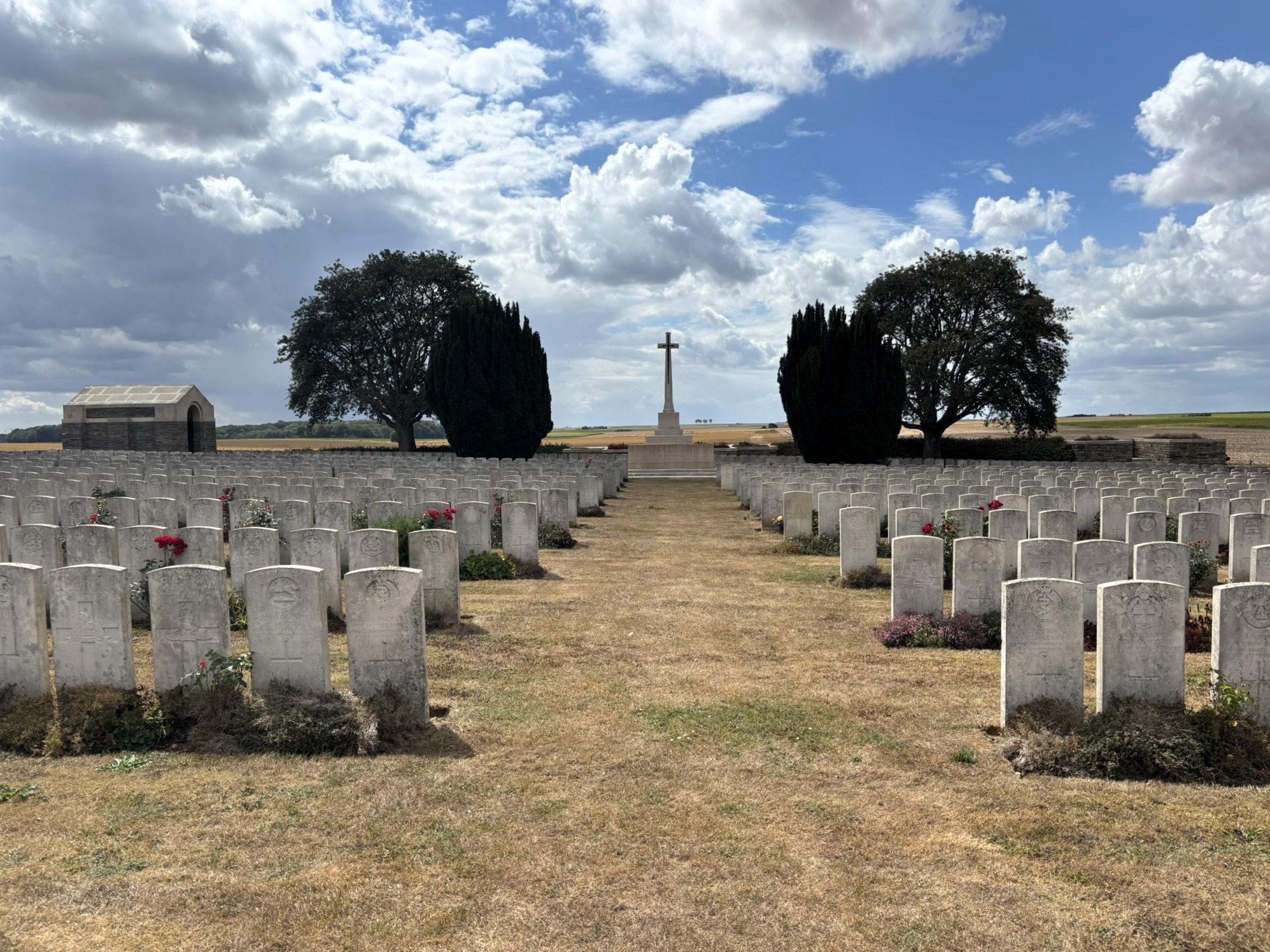
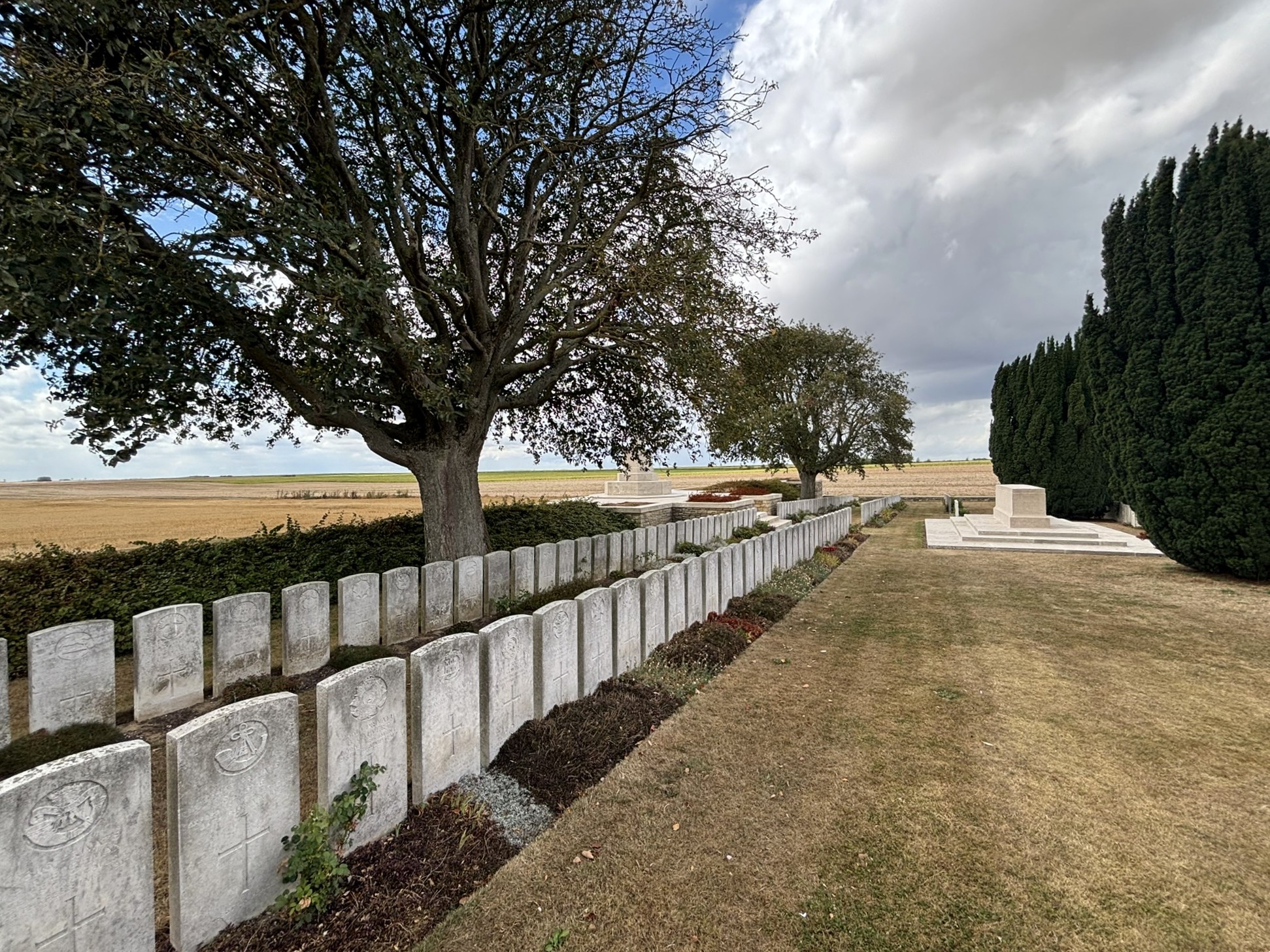
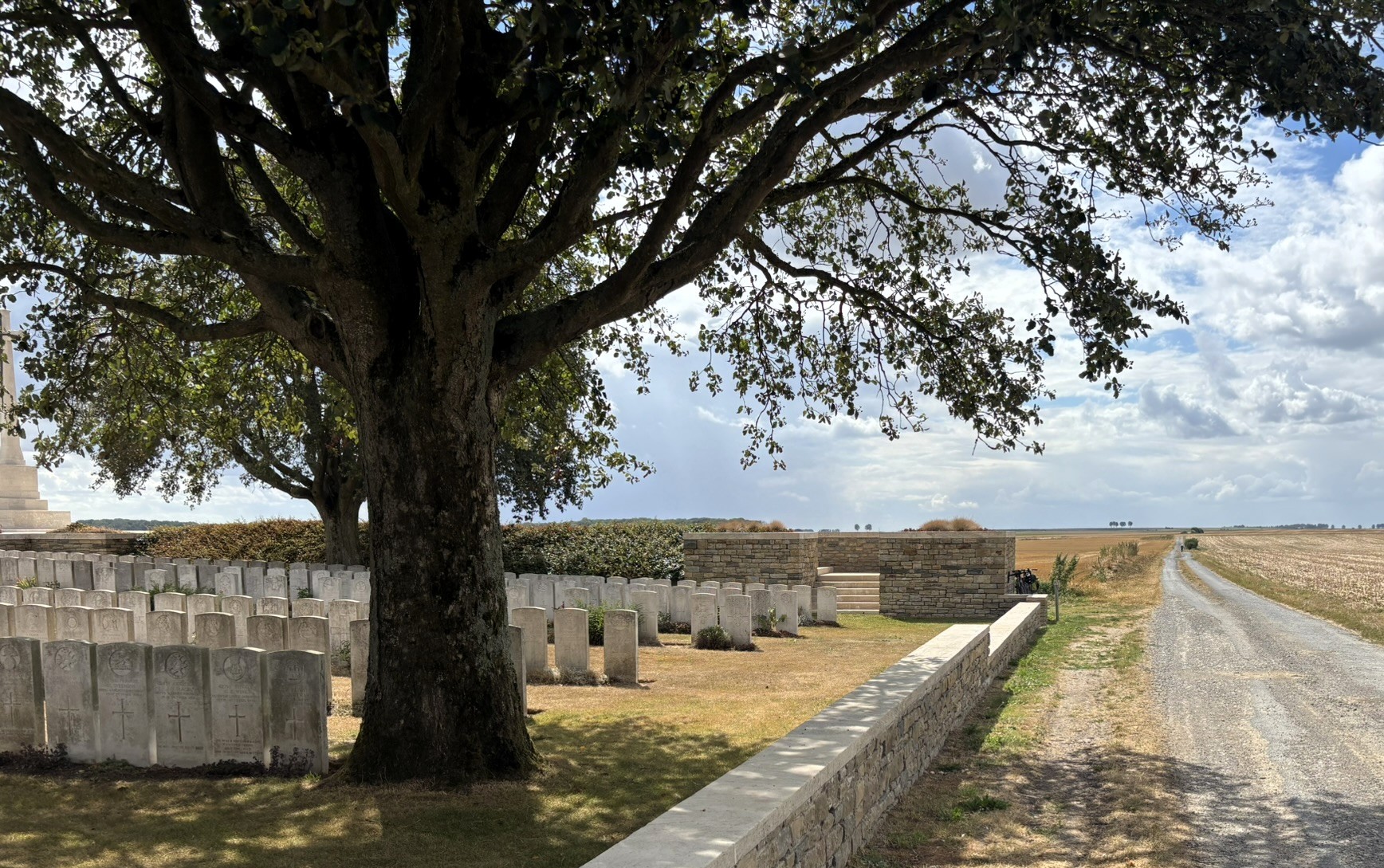
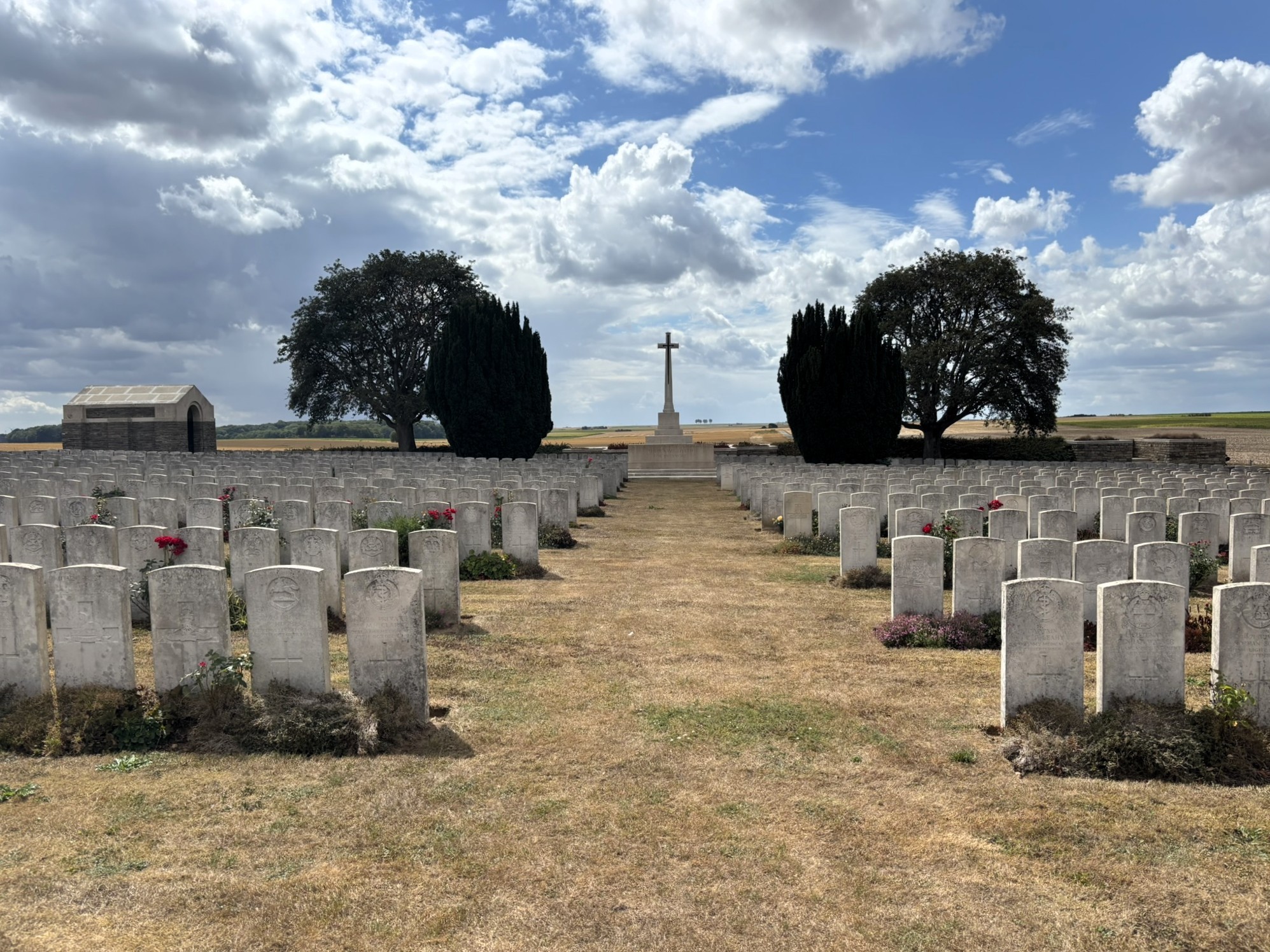
It was probably this flatness and hiding-in-plain-sight-ness that made the location so perfect for the establishment of casualty clearing stations in September 1916. Being far enough from the fighting lines it was possible to bury the dead here in relatively neat and ordered plots from the start which then left the Imperial War Graves Commission (IWGC) with a simple site to deal with when its staff began planning the permanent cemetery. Back in 1924 when work commenced to realise the designs of A.J.S. Hutton (under Lutyens as Principal Architect) there was a wider road running in front of the main cemetery gate, which is now little more than a track, but the sharp angle it created determined the shape of the first few rows of the cemetery and the diagonal front wall with its apsidal entrance. The main axis of the cemetery runs from the gate to the War Stone, which sits at the meeting point of the front two plots and the much smaller rear two plots.
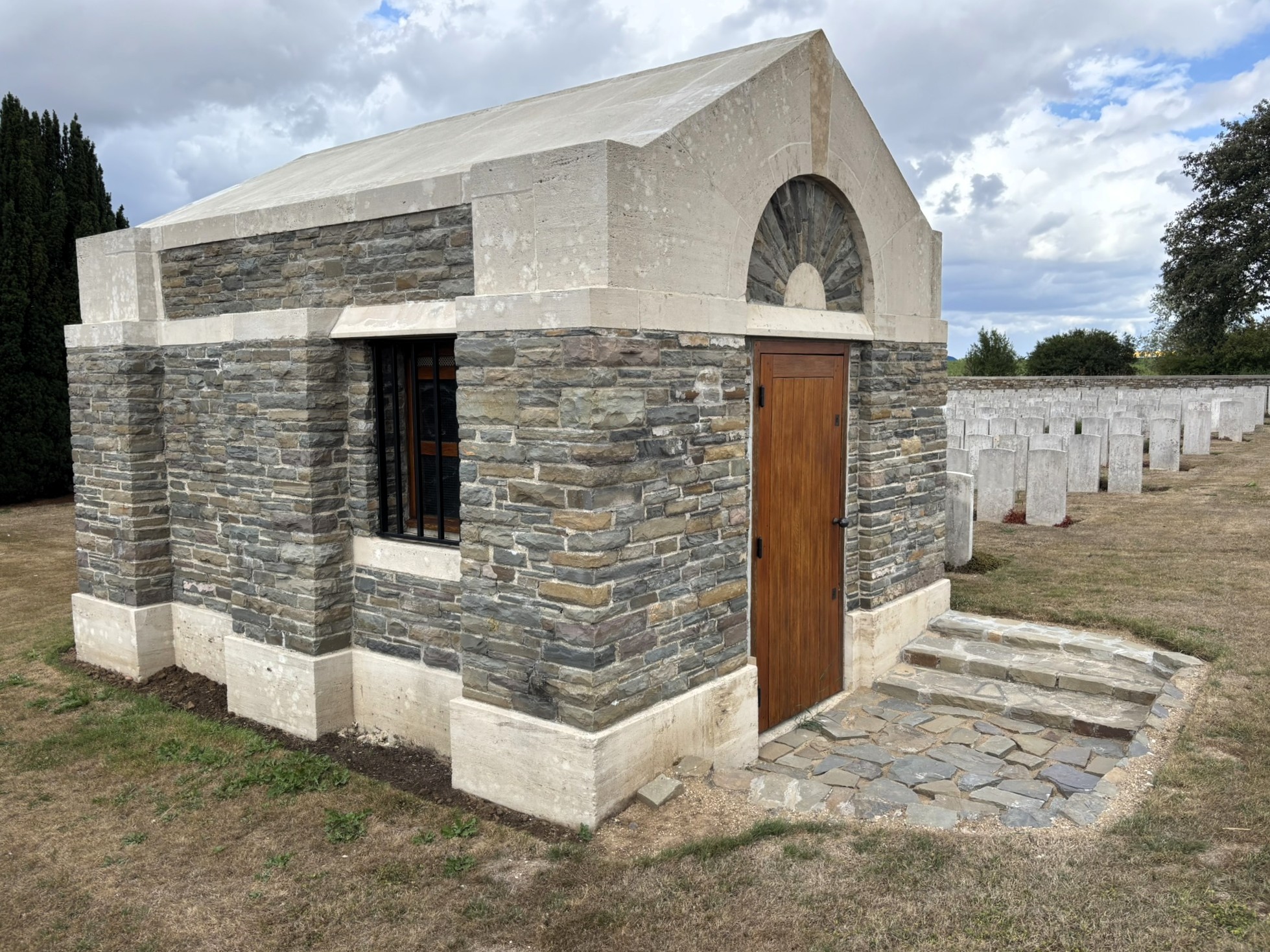
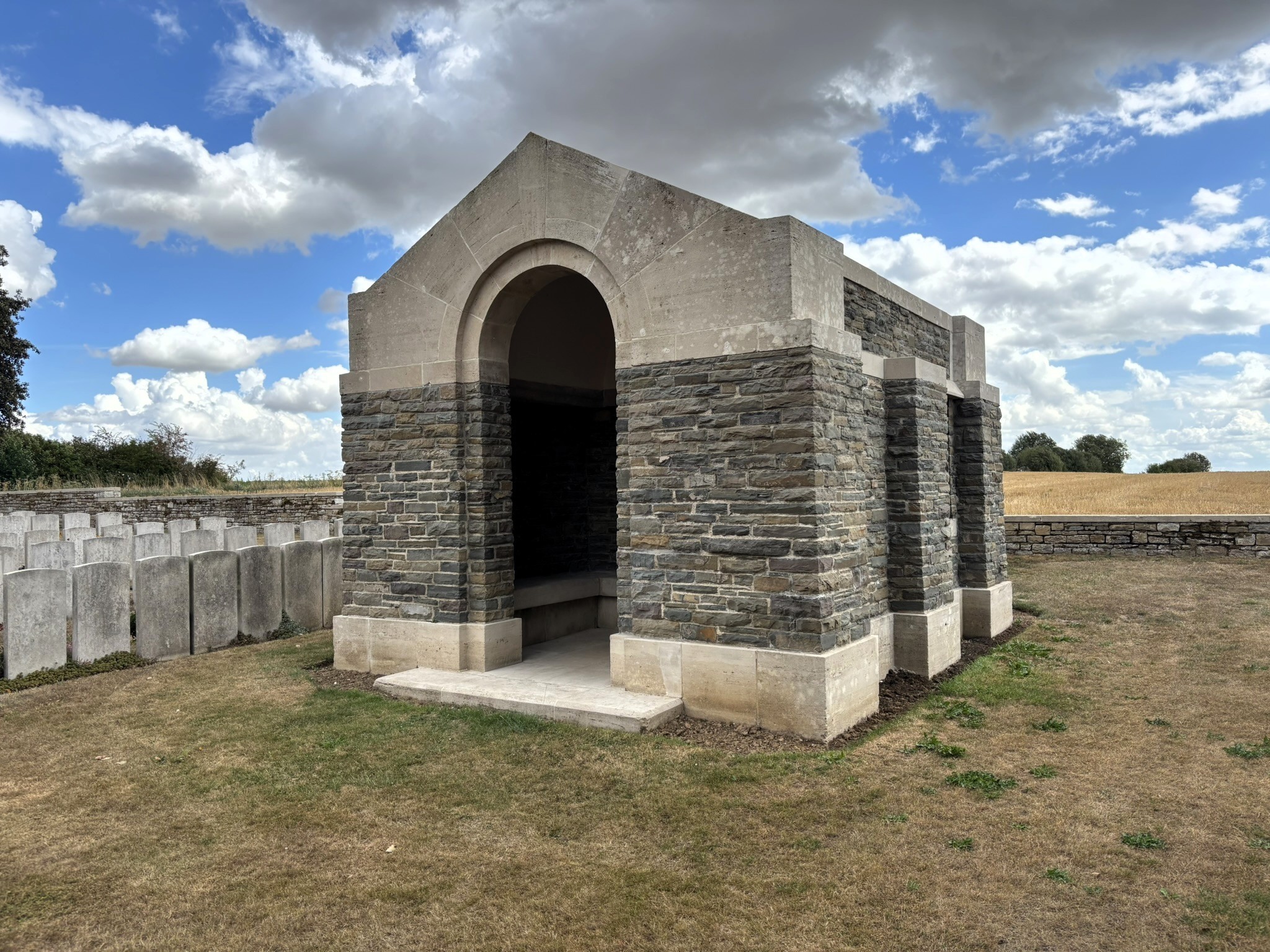
Standing at the cemetery gate and taking in the layout everything might seem very simple, but the real architectural glory of the site begins at the War Stone. We must get to that cross-axis and the junction of the plots to find some fascinating features. First, the shelter. It is a wonderful eccentricity. A recessed arched opening is topped by a saddleback roof seemingly in Massengis stone with rubble panels on each side. The stone top then gives way to rubble walls with three shallow buttresses which rest on a stone plinth. The rear quarter of the shelter is a storeroom with its door topped by a rubble fan.
Intriguingly, the shelter is not marked on the cemetery plan, which perhaps implies that it was a slightly later addition. (Have a look at this photograph in the Commission’s archive to get a sense of the cemetery immediately after completion.) The shelter certainly doesn’t look like anything Hutton did elsewhere in his work for the Commission and is far more like the shelter at Gorre Indian and British Cemetery designed by the Holden-Von Berg partnership.
Having taken in this distinctive feature, the eye is drawn to the next element. The rear boundary of the cemetery is in the form of an embankment which is tapered in line with the sloping gradient of the site. Level at the southern end, it gradually rises up against the back row of headstones in a rubble retaining wall topped with coping stones.
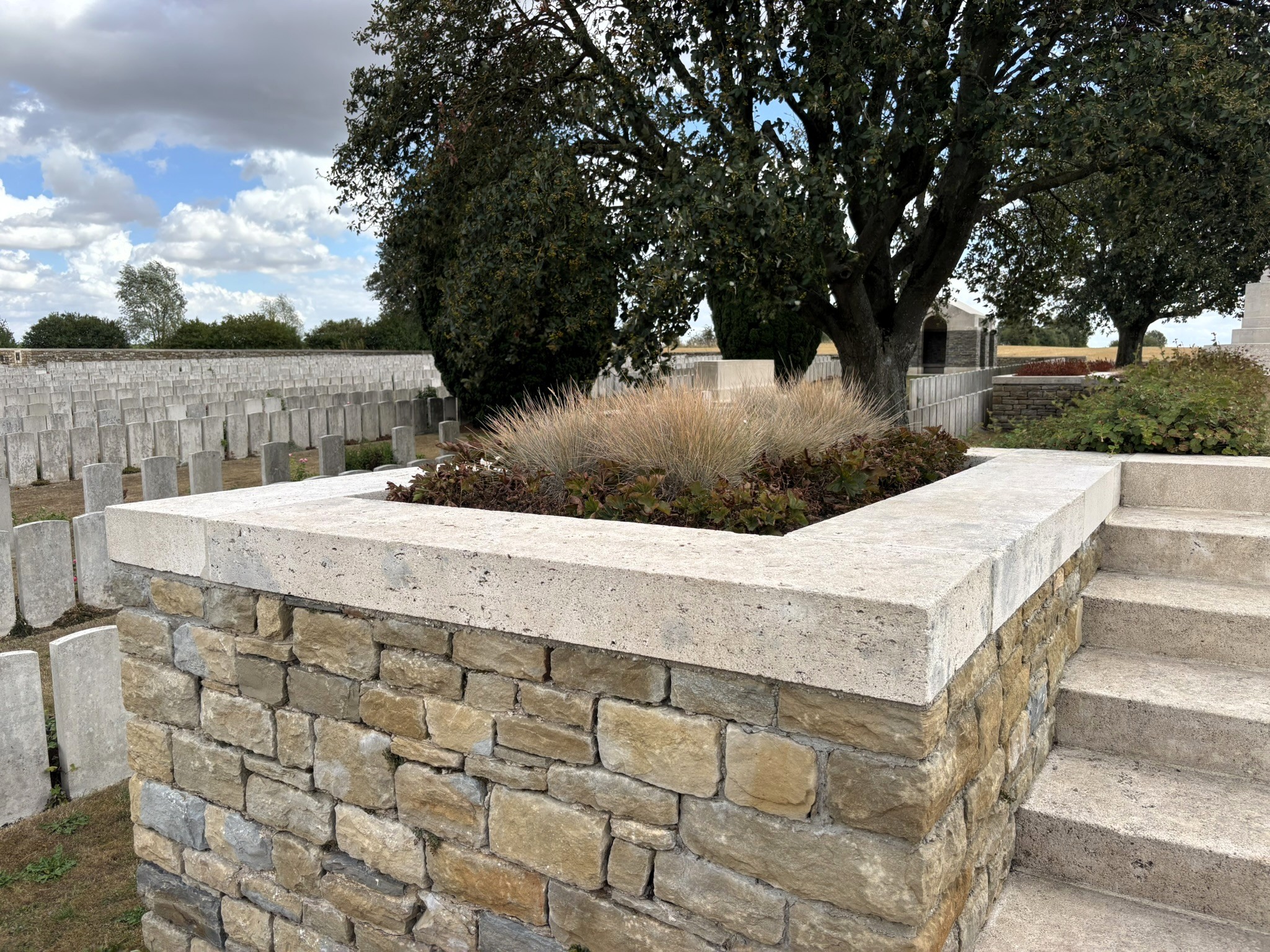
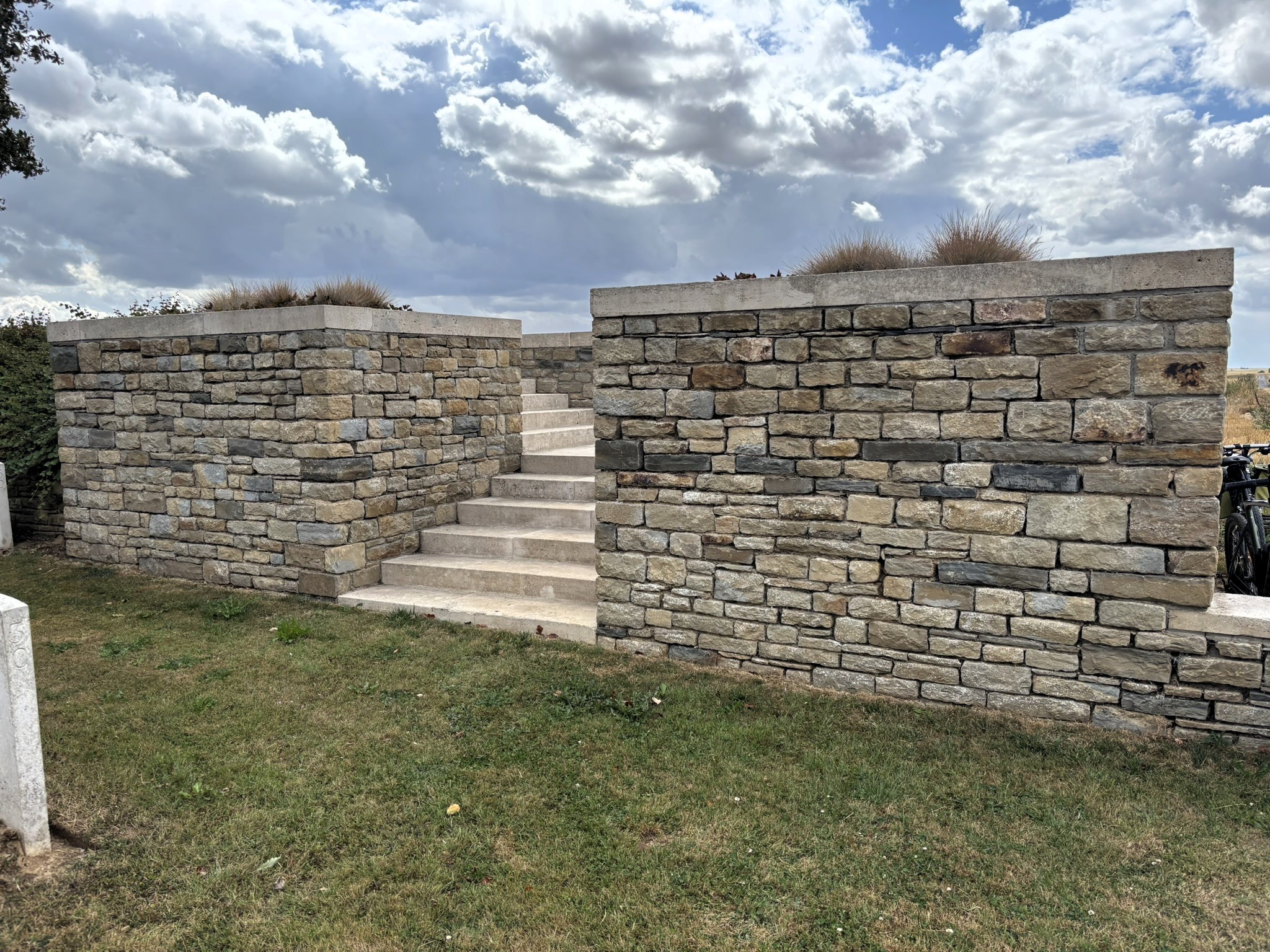
At its middle is the Cross of Sacrifice sat among two planters that project forward. At the northern end, the side running parallel with the access track from the road, there is an entrance point for the embankment formed by two brick planters and a right-angled flight of steps.
It is an absolutely charming feature, and has a similarity, though it is more modest, to the bulky embankment at the rear of Hawthorn Ridge No. 2 in Newfoundland Memorial Park. Hutton’s invitation to ascend the steps is as irresistible as he intended it to be. Look one way and the cemetery stretches out with the horizon broken by the rows of sentinel trees hugging the boundary. Turn and look the other way, and there is the plateau on which the casualty clearing station tents stood. Hutton makes us aware of the now vanished wartime space. We are invited to have eyes and senses capable of detecting ghosts in the landscape.
Come to the battlefields with me and walk in the footsteps of ghosts.