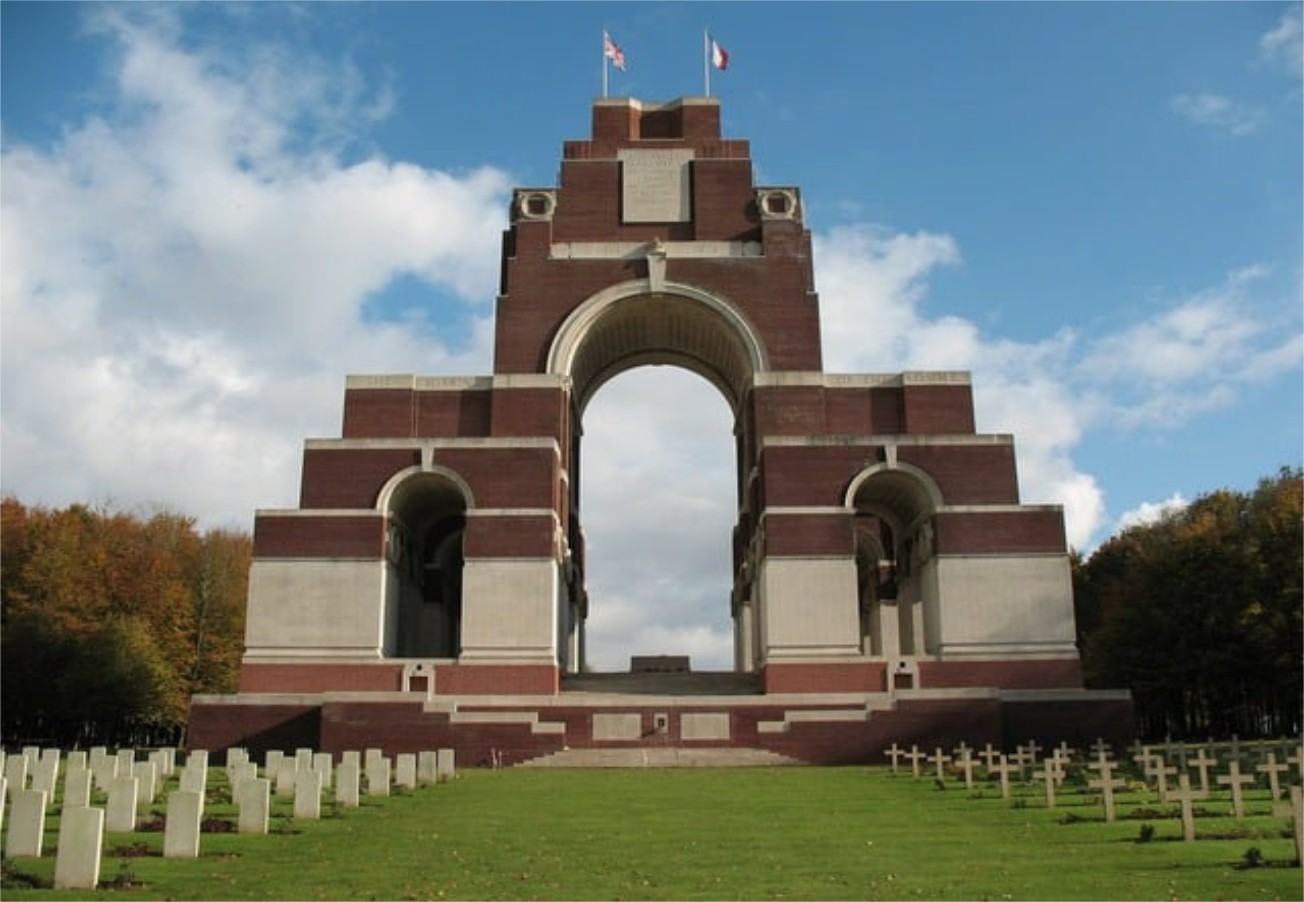
The village of Richebourg-L’Avoué is one of those myriad places on the Great War battlefields that do odd things to the emotions. The oddness rests in the dissonance between these small, quiet places and the enormous violence once expended in and around them. It is a strange feeling that probably far more people died in and around the village during the four years of the Great War than were ever born in it and lived out their peaceful lives in it.
During the course of the conflict, Richebourg-L’Avoué experienced a series of sanguine waves. In May 1915, during the Battle of Festubert, British soldiers created a cemetery in an old orchard near a forward dressing station. Fourteen months later, the 11, 12, 13 battalions of the Royal Sussex Regiment, advanced against a German position known as the Boar’s Head Salient. It was a disaster that brought the agony of grief to villages across the South Downs of Sussex. In April 1918, Richebourg-L’Avoué was overrun by the Germans and soldiers in field grey buried some of their dead in the British cemetery. Then, in September the same year British forces returned, and the cemetery gained a new plot containing the graves of eighteen British soldiers killed in the vicinity.
When the cemetery was handed over to the IWGC, design responsibility rested with the team of Charles Holden and Noël Rew. Together they produced a beautiful blend of their own particular signatures and styles. For Holden, St Vaast Post was clearly part of that brilliant group of pared-down, austere ‘elementalist’ cemeteries that are such a hallmark of his work for the Commission. Rew brought something else. Whilst his very successful work with Lutyens at cemeteries such as Hooge Crater and Serre Road No. 2 reveals he had a very fine understanding of classicism, here at St. Vaast Post, it is possibly the influence of the architect who recommended him to the IWGC, Reginald Blomfield, that we see.
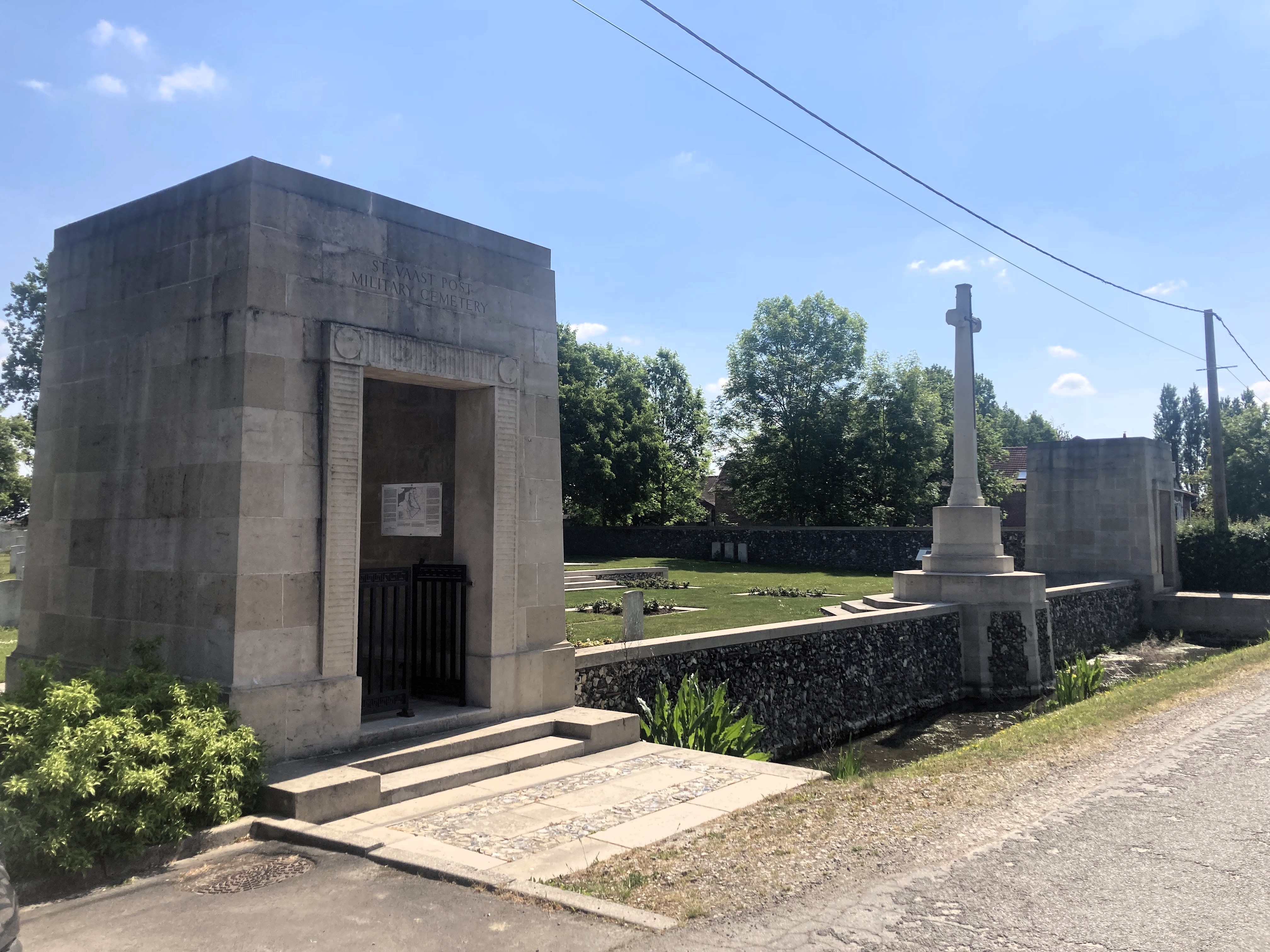
The glories of St. Vaast Post begin on arrival with its immediate surroundings, for it is fronted by a deep, wide drainage ditch. Seeing water and reeds conveys a sense of great peace and calm. The cemetery’s retaining wall is set at ground level and faced with flint. Flint relates the cemetery to England making it at one with churches across southern England and East Anglia. The wall has a coping stone, probably Massengis, and this flint rubble and coping combination is then repeated around the base of the War Stone. But what the eye takes in after the interesting combination of drama and peacefulness created by the ditch is the power of the entrance shelters.
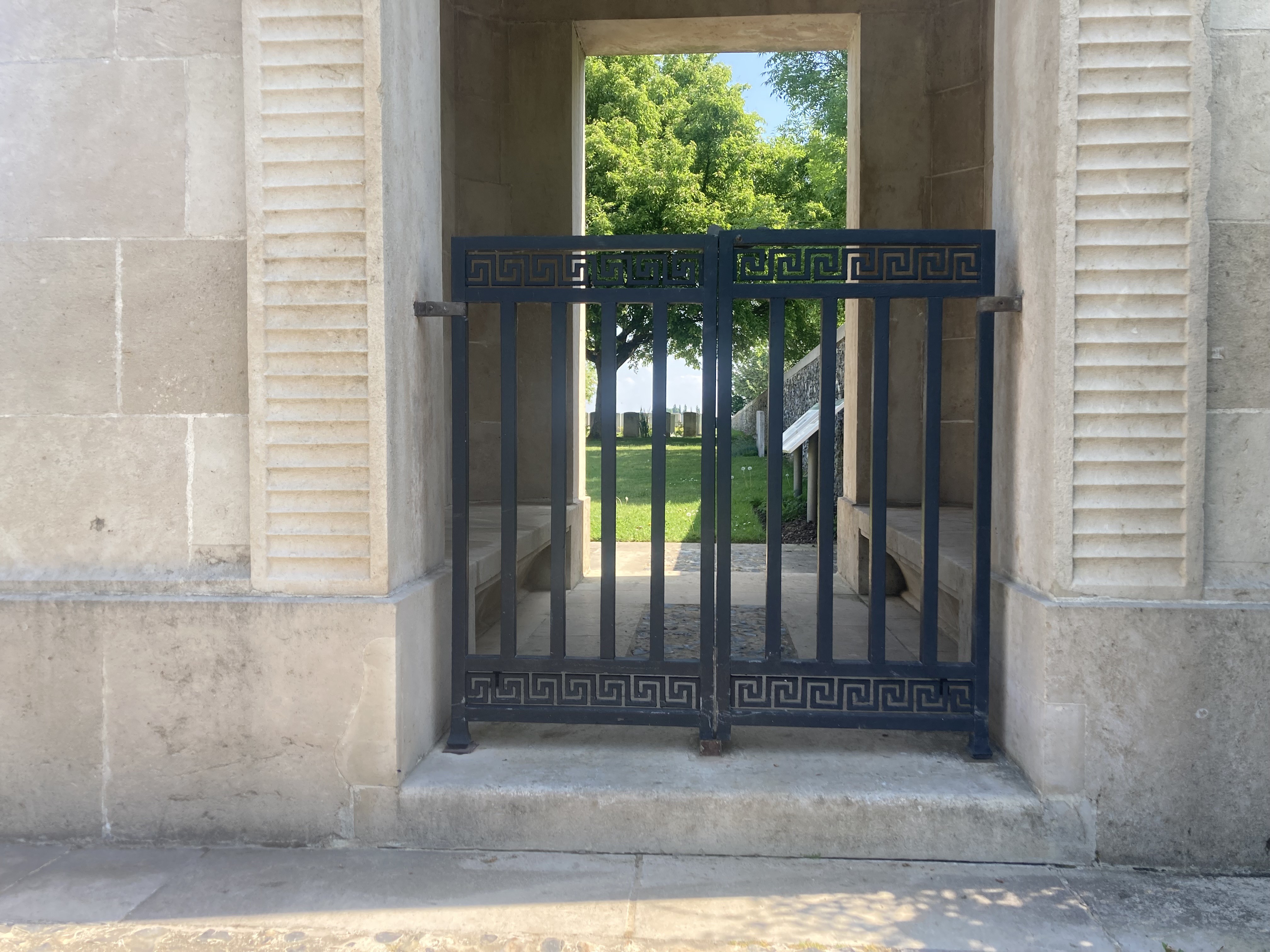
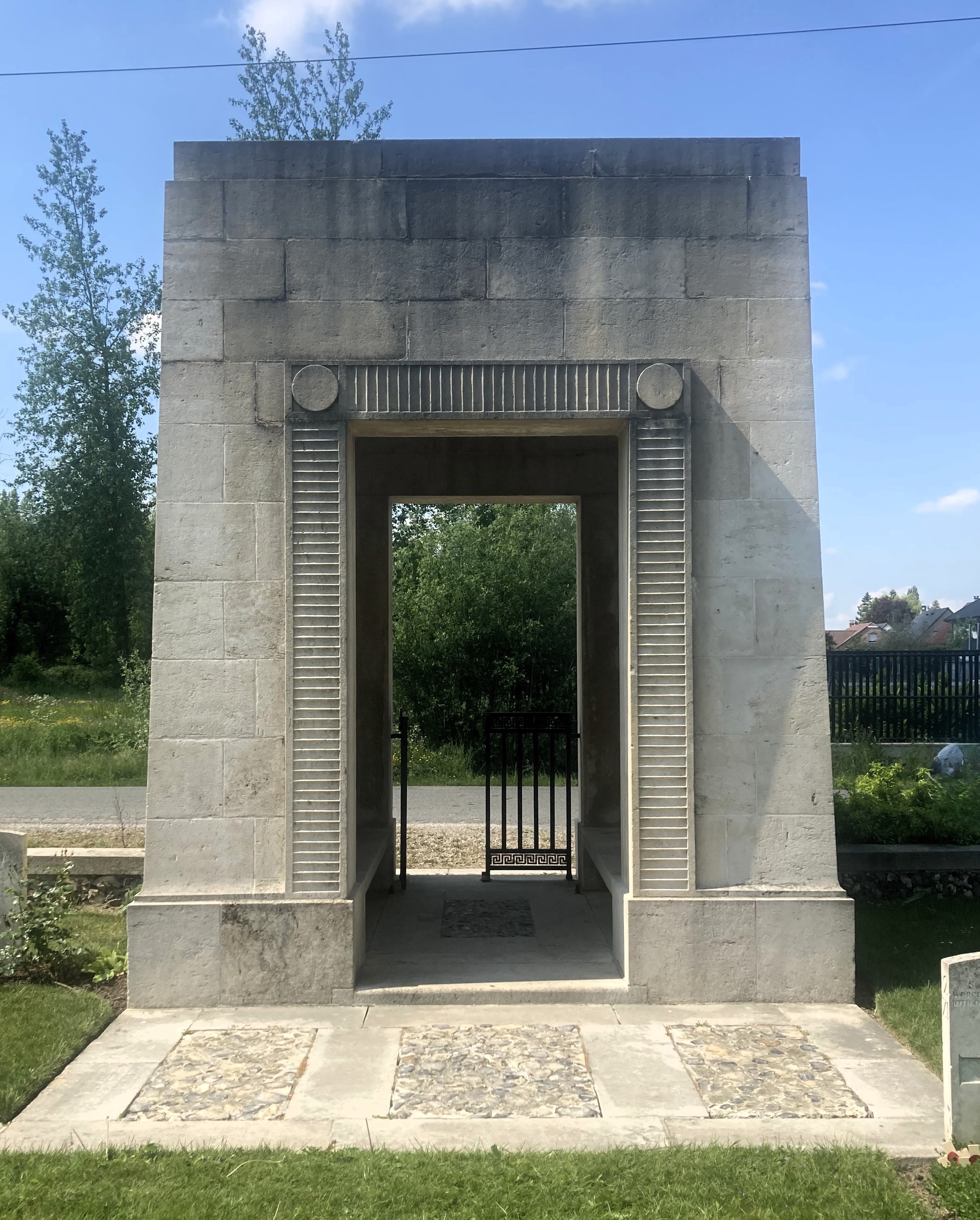
What Holden and Rew produced here is truly wonderful. They are very, very simple in form and taper slightly. In their stripped nature they seem to be a hangover from an earlier civilization, as if a Hittite gate had been transposed from the British Museum. But it is then made classical by the architrave around the aperture which is formed by an equally simple series of vertical slats appearing to hinge on circular discs at the apex. This seems very Blomfield; a little flourish to underline the classical references, as also seen in the ironwork of the gates with its key pattern.
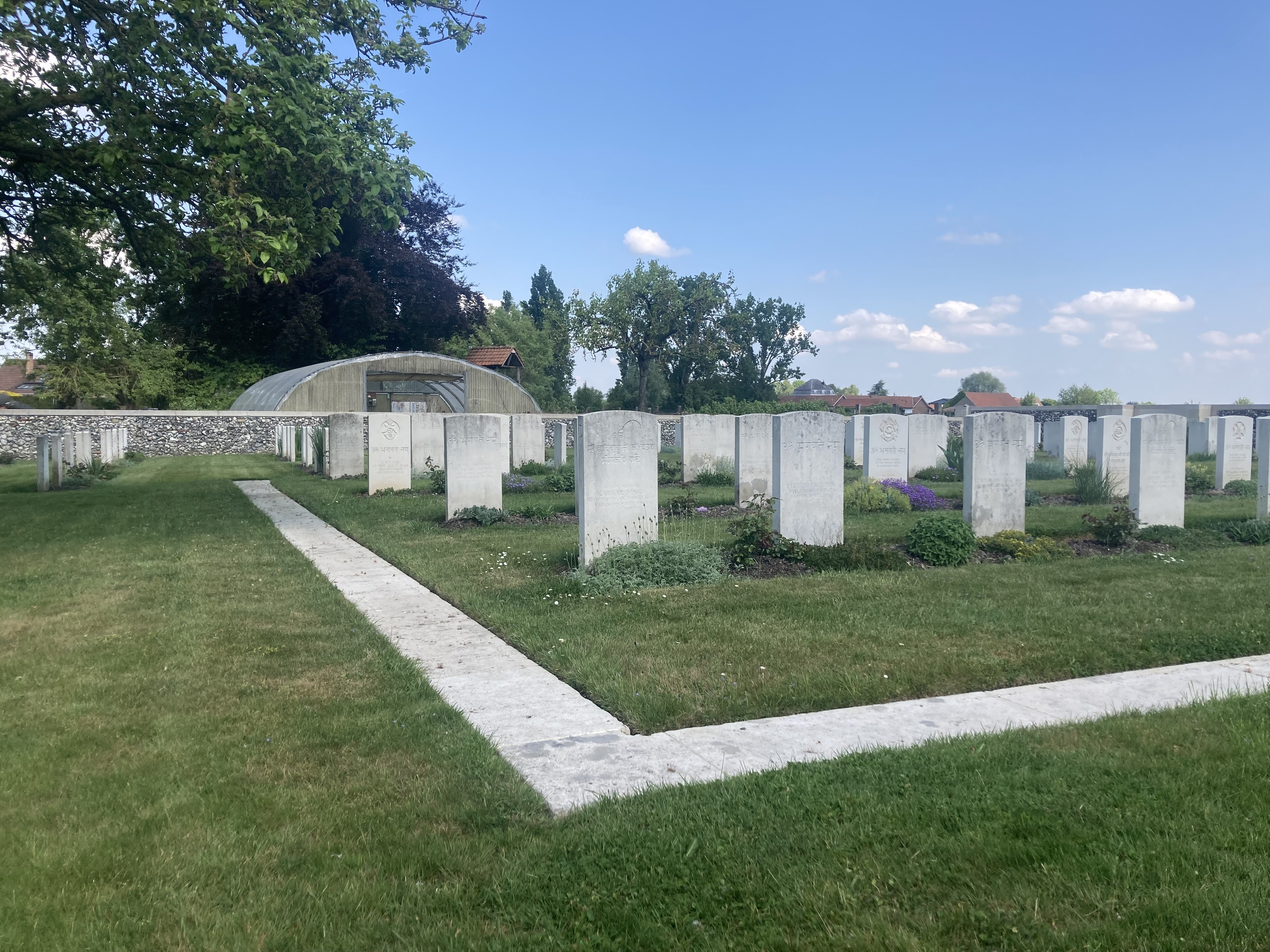
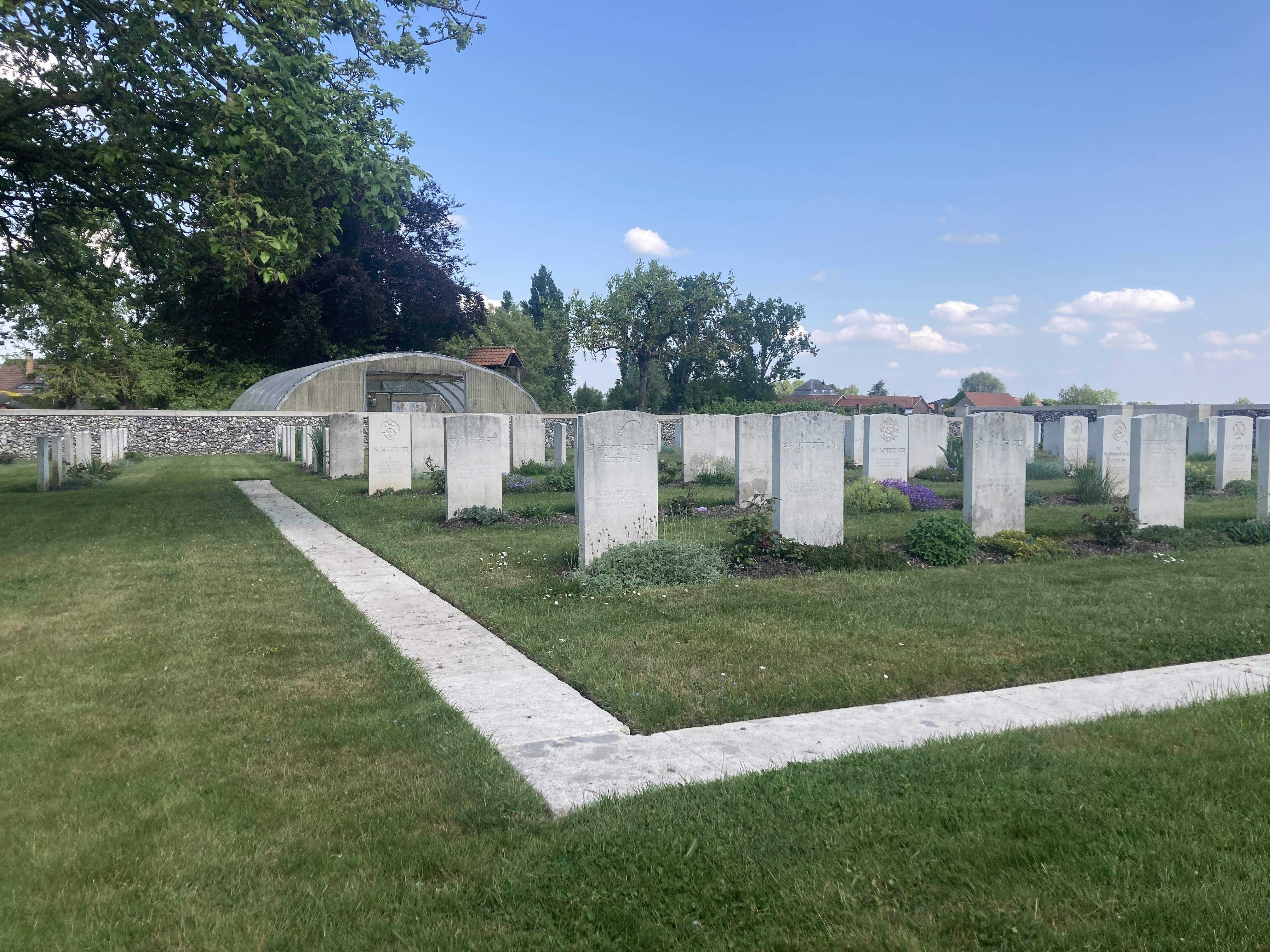
Once inside the cemetery, the parterres surrounding the War Stone stand out, which again has echoes of Blomfield and his interest in these features for garden design. Perhaps the most poignant and evocative use of parterres in the cemetery is the one that surrounds the Indian plot. By this subtle and delicate device, the Indian plot is made special and discrete, the graves given their own distinctive space but at one with their comrades within the cemetery.
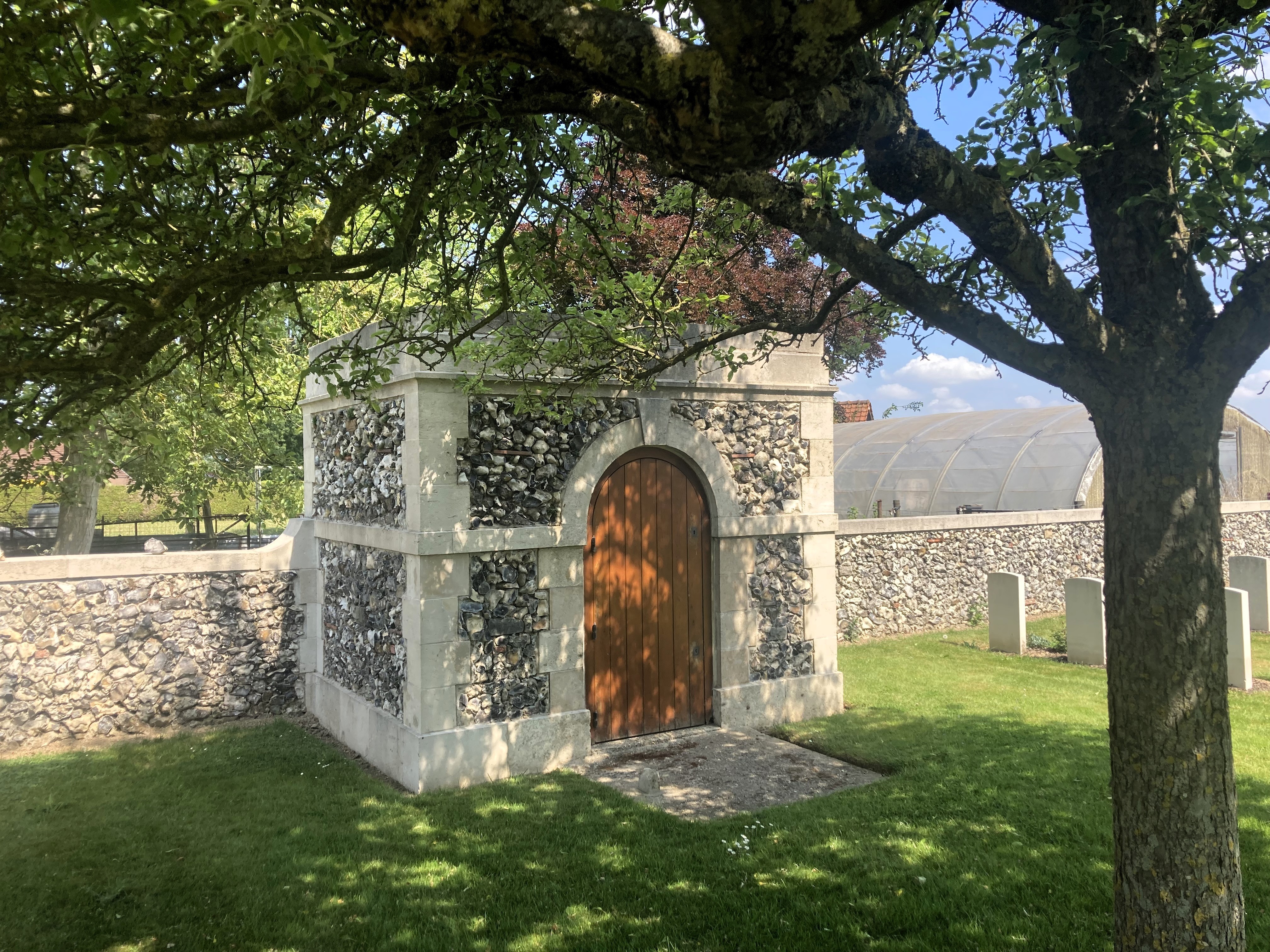
The tool shed adds something almost whimsical with its flint panels and stone string courses, but rather than tapering into a pyramidal roof, as Von Berg enjoyed doing in his cemeteries such as Bedford House, this one has that typical Holden lid top. It’s almost as if Holden decided to put the brakes on, lest the design be considered too picturesque. He sobers us through this almost brusque termination in a solid lintel. Through such an architectural device, did Holden decide to remind us that the men who sleep their permanent rest in these cemeteries lived in flat-topped dugouts while serving in the trenches?
The architecture and horticulture of every cemetery frame the dead and reward all those who contemplate their wonders with care, consideration and imagination.
Let’s do that together.